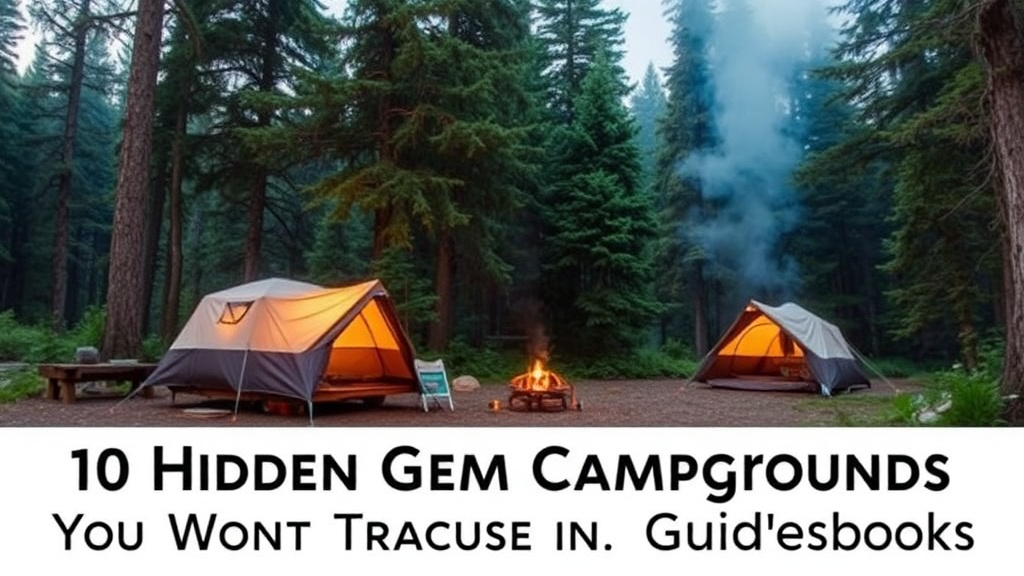
10 Hidden Gem Campgrounds You Won't Find in Guidebooks
This post reveals ten campgrounds that don't appear in mainstream guidebooks or apps like Campendium. These spots offer solitude, stunning scenery, and the kind of authentic outdoor experience that's disappearing from overcrowded national parks. You'll learn where to find them, how to access them, and what to expect when you arrive.
Where Can You Camp Without Fighting Crowds?
Dispersed camping on public lands remains the best-kept secret in outdoor recreation. On Bureau of Land Management (BLM) territory and National Forest land, you're free to camp almost anywhere outside developed areas. No reservations. No neighbors stacked 15 feet apart. Just you, the land, and whatever wildlife happens through.
The trick is knowing where to look. Most people open recreation.gov, see everything booked solid, and give up. That's the wrong approach. Here's the thing: over 245 million acres of BLM land exist across the Western states. Most of it has zero developed campgrounds. You're camping wherever your vehicle (or boots) take you.
Before heading out, check BLM's official camping guidelines for current rules and fire restrictions. Rules change seasonally, and rangers do patrol popular areas.
10 Under-the-Radar Campgrounds Worth the Drive
1. McGee Creek Canyon — Eastern Sierra, California
Tucked between Mammoth Lakes and Bishop, McGee Creek Canyon offers a stunning alternative to the packed campgrounds along Highway 395. The dirt road in requires some clearance—think Subaru Outback minimum—but rewards you with aspen groves, trout streams, and hiking trailheads that see maybe a dozen people on busy weekends.
Campsites sit alongside McGee Creek at 7,500 feet elevation. Summer temperatures rarely break 80°F. The catch? No services whatsoever. Bring the Jetboil Flash stove for quick morning coffee because gathering firewood gets tricky above treeline.
2. Cathedral Valley — Capitol Reef National Park, Utah
Everyone crowds into the Fruita Historic District. Meanwhile, Cathedral Valley sits 50 miles north, accessible only by rough dirt roads that wash out after rain. The payoff: camping beneath 400-foot sandstone monoliths with zero light pollution and absolutely no reservations required.
The primitive campground offers just six sites. No water, no trash pickup, no cell service. You need high clearance and possibly four-wheel drive depending on conditions. That said, on a moonless night, the Milky Way stretches from horizon to horizon like a river of light.
3. Long Draw Campground — Rocky Mountain National Park Vicinity, Colorado
Most visitors to Rocky Mountain National Park fight for spots inside the park boundaries. Long Draw sits in the adjacent Roosevelt National Forest, 35 miles from Estes Park. At 10,000 feet elevation, you'll get alpine meadows, wildflowers in July, and easy access to the Never Summer Wilderness.
The campground offers 18 sites for $20 per night. Vault toilets exist, but that's it for amenities. Worth noting: the road closes from October through June due to snow. Plan accordingly.
4. Pine Creek Wildlife Management Area — Nebraska Sandhills
The Nebraska Sandhills represent the largest stabilized dune field in the Western Hemisphere. Pine Creek WMA sits in the middle of it, offering free primitive camping along a spring-fed creek. You'll share the area with pronghorn antelope, mule deer, and over 200 bird species.
This isn't glamour camping. No picnic tables, no fire rings, just open grassland stretching to every horizon. Bring a sturdy tent—the wind blows constantly across these plains. The Big Agnes Copper Spur HV UL2 handles gusts better than most three-season alternatives.
5. Cape Perpetua Dispersed Sites — Oregon Coast
The Oregon Coast runs 363 miles, yet most travelers stick to Highway 101 and state parks. Cape Perpetua offers a different experience entirely. Forest Service roads above the visitor center branch into dozens of pullouts suitable for vans and small RVs.
You'll wake up 800 feet above the Pacific, watching fog roll in and out through old-growth Sitka spruce. Thor's Well and the Devil's Churn sit just down the hill. The sites are free but limited—arrive before 4 PM on weekends or keep driving up Forest Road 55 for more options.
6. Mather Campground Alternative — Grand Canyon North Rim
Grand Canyon's North Rim receives 10% of the visitation that swamps the South Rim. While everyone's trying to book spots at the developed campground, dispersed camping exists on adjacent Kaibab National Forest land. Forest Road 611 and 219 offer pullouts with canyon views—legally, for free.
The North Rim sits 8,000 feet up. Nights drop to 40°F even in summer. Bring the Nemo Disco 15 sleeping bag or similar. The aspen forests here turn gold in late September, making this one of the Southwest's best autumn camping secrets.
7. Sage Creek — Badlands National Park, South Dakota
Sage Creek Campground offers free primitive camping inside a national park. That's rare. No reservations, no fees, just 22 sites along a gravel road where bison wander through at dawn. Prairie dogs bark constantly from their colonies nearby.
The road gets rough after rain. Vault toilets exist but often run low on supplies mid-summer. Pack out everything. The stargazing here rivals any International Dark Sky Park—Badlands earned that designation in 2023.
8. Valley of the Gods — Bears Ears National Monument, Utah
Monument Valley gets the postcards. Valley of the Gods gets the solitude. This 17-mile dirt loop winds through red rock formations that rival anything in Arizona, with 12 designated primitive campsites scattered along the route.
The road is washboard but manageable for most vehicles in dry conditions. Each site offers a different view—castle-like buttes, balanced rocks, endless desert sky. No water, no shade, no cell service. Come prepared or don't come at all.
9. Pass Creek Campground — Bighorn National Forest, Wyoming
Most Yellowstone-bound travelers blast straight through the Bighorns on Interstate 90. Pass Creek sits 25 miles off that route, deep in spruce-fir forest at 8,400 feet. The campground offers 12 sites, a stream stocked with cutthroat trout, and proximity to the Cloud Peak Wilderness.
Mosquitoes thrive here in July. August and September deliver perfect conditions—crisp mornings, warm afternoons, and aspens turning gold along the creek. The nearest town, Buffalo, sits 40 miles away. Stock up on groceries and ice before heading up the mountain.
10. Kisatchie Bayou Recreation Area — Kisatchie National Forest, Louisiana
Not every hidden gem sits in the mountains. Kisatchie Bayou offers something the American West can't match: cypress trees draped in Spanish moss, bayous perfect for kayaking, and longleaf pine forests that predate European settlement.
The recreation area provides free primitive camping along Kisatchie Bayou. Paddle upstream through cypress knees and water tupelos. Watch for wood ducks, prothonotary warblers, and the occasional alligator sunning on the bank. It's humid. It's buggy. It's absolutely unforgettable.
What Gear Works Best for Remote Camping?
Remote sites demand self-sufficiency. You're not driving to a camp store for ice or firewood. The gear you bring matters more when help sits hours away.
| Item | Budget Option | Upgrade Pick | Why It Matters |
|---|---|---|---|
| Water Storage | Reliance Aqua-Pak 5 gal | Dromedary Bags by MSR | No spigots at primitive sites |
| Power | Goal Zero Nomad 10 | Jackery Explorer 300 | Phone, GPS, camera charging |
| Shelter | Coleman Sundome 4 | REI Co-op Trail Hut 4 | Weather protection when exposed |
| Navigation | Gaia GPS phone app | Garmin inReach Mini 2 | No cell service, no street signs |
| Cooking | Coleman Classic stove | Partner Steel 2-burner | Reliable meals without restaurants |
Water tops the list of concerns. Most dispersed sites have no potable sources. Plan for one gallon per person per day—two if you're active in heat. The Reliance containers work fine for car camping. For backpack-in sites, MSR's Dromedary bags pack smaller and weigh less.
Communication gear deserves serious consideration. Cell service dies within a few miles of most paved roads. A satellite communicator like the Garmin inReach Mini 2 provides two-way messaging and emergency SOS capability. It's not cheap. Neither is a Search and Rescue bill.
How Do You Actually Find These Places?
The best sites never appear on Recreation.gov or ReserveAmerica. You find them through a combination of tools, persistence, and willingness to explore dead-end roads.
Start with Motor Vehicle Use Maps (MVUMs) from the Forest Service. These free maps show exactly which roads are open to vehicles and where dispersed camping is permitted. They're more reliable than apps. Download the PDF versions before leaving home—cell service rarely cooperates when you actually need it.
Another strategy: follow power lines and pipelines. These corridors often have access roads cutting through remote public land. The roads aren't pretty, but they reach places no tourist ever considers. Just respect gates and signage. Closed means closed.
Talk to locals. The cashier at the gas station near the national park entrance. The bartender at the small-town tavern. The ranger at the obscure Forest Service office, not the crowded visitor center. These people know which roads wash out, which sites just opened after being closed for years, and where the elk herds are currently gathering.
What's the Real Etiquette for Hidden Camps?
These places stay hidden because people protect them. Posting GPS coordinates on Instagram destroys them. The Leave No Trace principles matter more here than anywhere—there's no cleanup crew following behind you.
Pack out everything. That includes toilet paper (burying it doesn't work as well as you think). Stay on existing roads—creating new tracks scars the landscape for decades. Keep fires small and fully extinguished. Many of these areas have fire bans most of the year anyway—a Camp Chef Everest 2X stove handles cooking without the risk.
If you arrive at a dispersed site and someone's already there, keep driving. The unwritten rule is at least 200 yards between camps—preferably out of sight and sound. Don't walk through someone else's camp to get to a viewpoint. Don't play music. Don't run generators after 8 PM (or ideally, ever).
The reward for following these rules is continued access. Land managers close areas when abuse gets too high. Every user who violates the social contract makes it harder for everyone else. These ten spots exist because people before you treated them with respect. Pass that gift forward.
So load up the rig. Check the tire pressure. Download offline maps. And go find something that isn't in any guidebook—because the best campsites aren't listed. They're discovered.