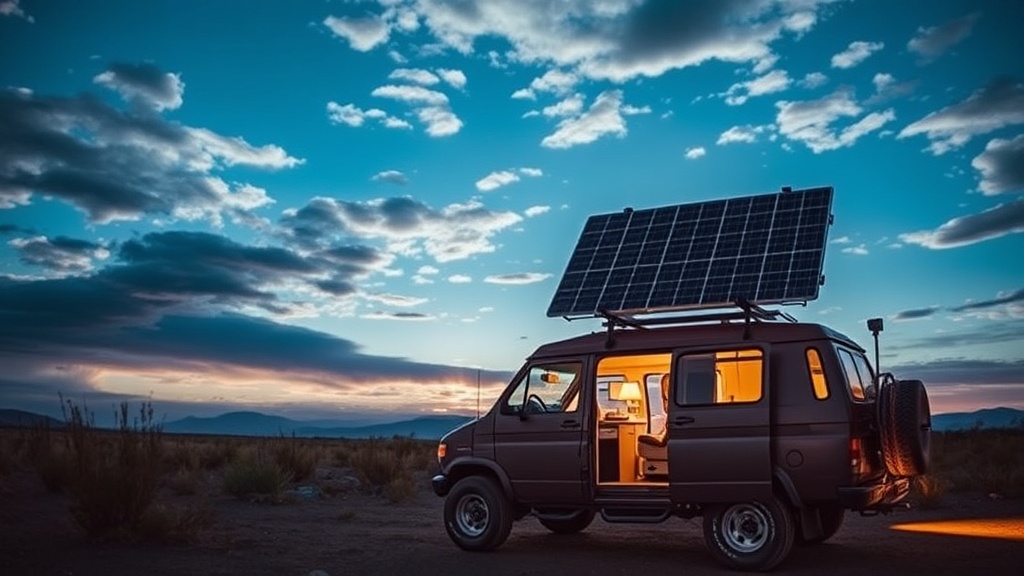
Building a Reliable Solar Power Array for Your Van Life Setup

Have you ever woken up in a beautiful desert campsite near Moab, only to realize your laptop is dead and your portable fridge has shut off because your battery levels dropped too low overnight?
Building a reliable solar power array is often the most intimidating part of a van conversion, but it is the single most important factor in achieving true off-grid independence. A poorly planned system will leave you tethered to crowded RV parks with hookups, whereas a robust, well-calculated solar setup allows you to stay out on public lands for weeks at a time. This guide breaks down the technical requirements, component selection, and installation logic needed to create a system that actually performs when the weather turns.
Understanding Your Daily Power Budget
Before you purchase a single panel, you must calculate your total daily Watt-hour (Wh) consumption. A common mistake is looking only at Amps or Volts, but calculating total energy consumption provides a much clearer picture of your needs. You need to account for every device that draws power, even the ones that seem negligible.
Create a spreadsheet or a list of every component in your van. For example, a 12V compressor fridge like the Dometic CFX3 might consume roughly 40–60 Amp-hours (Ah) per day depending on the ambient temperature. A 60W laptop charger used for three hours consumes 180Wh. A 12V vent fan running for 10 hours might consume 30Ah. If you add a 12V water pump, LED lighting, and a USB charger for your phone, your daily total might sit between 1,500Wh and 2,500Wh.
Once you have your total daily Watt-hours, you must build in a safety margin. I recommend a 25% to 30% buffer to account for "dark days"—those stretches of overcast weather or heavy tree canopy where your panels underperform. If your calculated need is 2,000Wh, you should design a system capable of producing at least 2,600Wh under ideal conditions.
Selecting the Right Solar Panels: Rigid vs. Flexible
The choice between rigid monocrystalline panels and flexible panels usually comes down to your vehicle's roof geometry and your long-term durability requirements. While flexible panels look sleek and follow the curves of a van roof, they are often less efficient and more prone to degradation due to heat buildup underneath the panel.
Rigid Monocrystalline Panels
Rigid panels, such as those made by Renogy or Boult, are the gold standard for reliability. They are constructed with tempered glass that protects the cells from hail and debris. Because they are mounted slightly off the roof using Z-brackets or specialized mounting rails, air can flow underneath them. This airflow is crucial because solar cells lose efficiency as they get hot. A rigid panel mounted with a 1-inch gap will perform significantly better in the high heat of the Mojave Desert than a panel pressed directly against the metal roof.
Flexible Solar Panels
Flexible panels are excellent for curved surfaces like the roof of a Volkswagen Westfalia or a smaller camper van where every inch of space matters. They are lightweight and easy to install with adhesive, but they have a shorter lifespan. If you choose this route, ensure you are using high-quality ETFE (Ethylene Tetrafluoroethylene) coated panels rather than cheaper PET versions, as ETFE is much more resistant to UV degradation and extreme temperature swings.
The Core Components: Controller, Battery, and Inverter
A solar array is only as good as the hardware that manages the energy. You need a cohesive system consisting of a charge controller, a battery bank, and an inverter.
MPPT vs. PWM Charge Controllers
Do not settle for a PWM (Pulse Width Modulation) controller. While they are cheaper, they are significantly less efficient because they cannot optimize the voltage from your panels to match your battery's requirements. You should always use an MPPT (Maximum Power Point Tracking) controller. An MPPT controller, like the Victron SmartSolar series, can increase the efficiency of your system by up to 30% by converting excess voltage into additional amperage. This is the difference between a full battery and a depleted one during a cloudy week in the Pacific Northwest.
Choosing the Right Battery Chemistry
The era of Lead-Acid and AGM (Absorbent Glass Mat) batteries is ending for mobile setups. While they are inexpensive upfront, they are heavy, have a low depth of discharge (DoD), and cannot handle frequent cycling. For a modern van life setup, LiFePO4 (Lithium Iron Phosphate) is the industry standard. A 100Ah LiFePO4 battery can be discharged to nearly 0% without damage, whereas an AGM battery should never be discharged below 50% if you want it to last. This means a 100Ah Lithium battery provides roughly double the usable energy of a 100Ah AGM battery in a real-world application.
Inverter Selection: Pure Sine Wave vs. Modified Sine Wave
If you plan to run anything more complex than a simple lightbulb—such as a laptop charger, a coffee maker, or a specialized medical device—you must use a Pure Sine Wave Inverter. Modified sine wave inverters are cheaper, but they produce "dirty" electricity that can damage sensitive electronics or cause motors to run hot and inefficiently. A high-quality 2000W Pure Sine Wave inverter from a brand like Renogy or Giandel ensures your electronics remain safe and functional.
Installation Best Practices and Safety
Wiring a solar system is not just about making connections; it is about managing resistance and ensuring safety. A single loose wire or an undersized cable can lead to a fire or a massive loss in power efficiency.
- Calculate Wire Gauge: Use an online wire gauge calculator to determine the correct thickness for your cables. If you are running a long wire from your roof panels down to your charge controller, you need thicker wire (lower gauge number) to prevent voltage drop. A 10-foot run of 10AWG wire might be fine for a small panel, but a 20-foot run may require 8AWG to ensure the energy actually reaches your battery.
- Install Fuses and Breakers: Every single connection point in your system should have a fuse or a circuit breaker. You need a fuse between the solar panels and the charge controller, between the charge controller and the battery, and between the battery and the inverter. This prevents a short circuit from turning your van into a bonfire.
- Grounding: Ensure your system is properly grounded to the vehicle chassis. This provides a path for static electricity and helps mitigate electromagnetic interference.
- Ventilation: Even though LiFePO4 batteries do not off-gas like traditional lead-acid batteries, your inverter and charge controller will generate heat. Mount them in a location with adequate airflow, away from direct sunlight or heat-producing appliances.
The Importance of Monitoring
You cannot manage what you do not measure. A reliable solar setup requires a real-time monitoring system. Relying on a simple voltmeter is insufficient because voltage fluctuates based on load and temperature, often giving false readings. Instead, invest in a Battery Monitor with a Shunt, such as the Victron BMV-712. A shunt measures the actual current flowing in and out of the battery, providing a highly accurate percentage of your remaining capacity.
If your budget allows, look for a system that offers Bluetooth connectivity. Being able to check your solar production, battery voltage, and real-time consumption from your smartphone while you are sitting in the driver's seat or even outside the van is an invaluable tool for making informed decisions about when to use heavy appliances and when to conserve energy.
Final Checklist for Success
Before you head out on your next road trip, perform a "stress test" on your system. Set up your van in your driveway or a local park and run your most power-intensive devices—the fridge, the laptop, the lights—for 24 hours. Observe how the solar panels replenish the battery throughout the day and how much the battery drains at night. This real-world test will reveal any weaknesses in your wiring or undersized components before you find yourself stranded in a remote area without power.
Building a solar array is a technical endeavor, but with the right components and a focus on math rather than guesswork, you can create a system that provides the freedom to explore the most remote corners of the country with total confidence.
Steps
- 1
Calculate Your Daily Watt-Hour Consumption
- 2
Select Your Solar Panels and Charge Controller
- 3
Choose the Right Battery Bank Type
- 4
Mount Panels and Wire the System