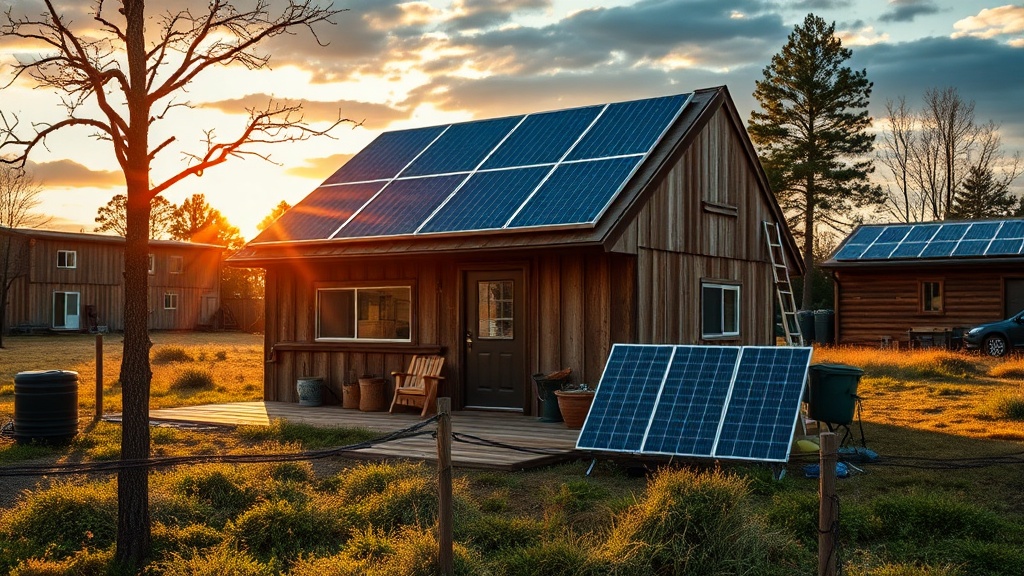
Building a Reliable Solar Setup for Long-Term Off-Grid Living

Why Solar Power Matters When You're Living on the Road
A single cloudy day can drop your battery voltage by 30% faster than you might expect, often leaving travelers stranded without light or a way to run a water pump. When you live in a van or a trailer, your power isn't just a luxury—it's your life support system. Relying on a single source of power is a recipe for stress. This guide covers how to select, install, and maintain a solar-based power system that actually keeps up with your daily energy consumption, ensuring you aren't left sitting in the dark when the sun dips below the treeline.
Most people start with a single portable panel, but that's rarely enough for a full-time setup. You need to understand the relationship between your solar panels, your charge controller, and your battery bank. If these parts aren't talking to each other correctly, you're essentially throwing energy away. I've seen so many people buy expensive lithium batteries only to realize their solar panels can't actually charge them fast enough during the winter months. It's a common pit-fall that turns a dream road trip into a frustrating search for a way to plug in.
How much solar wattage do I actually need?
Calculating your needs starts with your total daily watt-hour consumption. Don't just look at your biggest appliance; look at the small stuff. A single laptop charger might use 60 watts, but if it runs for four hours, that's 240 watt-hours. Your lights, your fridge, and even your phone chargers add up. A good rule of thumb is to find your total daily watt-hour usage and then divide that by the number of "peak sun hours" your destination gets. For example, if you're in the high desert, you might get 6 hours of peak sun. If you need 2,400 watt-hours a day, you need at least 400 watts of panels to stay level.
Keep in mind that real-world output is rarely 100% of what the sticker says. Dust, shadows from a nearby tree, or even the angle of your van can slash your efficiency. I always suggest over-specifying your solar array by at least 20-30%. If you think 200 watts is enough, aim for 300. This buffer covers you on those gray, overcast days when the sun feels more like a suggestion than a constant source of energy. You can check the National Renewable Energy Laboratory website to get a better idea of solar irradiance in different regions before you head out on your trip.
Should I use a PWM or an MPPT charge controller?
This is where many beginners get stuck. A PWM (Pulse Width Modulation) controller is the cheaper, simpler option. It works by essentially "chopping" the voltage from your panels to match your battery. It's fine for a small, basic setup, but it's inefficient. An MPPT (Maximum Power Point Tracking) controller is a different beast. It acts like a smart transformer, constantly adjusting to find the most efficient way to pull power from the panels. While it costs more upfront, the ability to squeeze every drop of energy out of a cloudy day makes it worth the investment.
If you're running a lithium battery system—which most modern rigs are—an MPPT is almost a requirement. Lithium batteries have a very specific charging profile, and an MPPT will respect those boundaries much better than a cheap PWM. If you use a controller that doesn't match your battery type, you risk shortening the lifespan of your expensive battery bank. It's one of those areas where spending a bit more now saves you from a massive headache (and a dead battery) later.
How do I prevent battery drain during cloudy weather?
The biggest fear for anyone living off-grid is the "blackout." When the sun disappears for three days, your solar panels become much less effective. To prevent this, you need to manage your load. This means being disciplined about when you use high-draw devices. Don't run your blender or a high-wattage hair dryer when your batteries are already hovering at 40%. Instead, try to time your heavy energy use for the middle of the day when the sun is brightest and your panels are working at full tilt.
Another strategy is to monitor your "depth of discharge." If you're using Lead Acid or AGM batteries, you should never drop below 50% capacity. For Lithium (LiFePO4), you can go much lower, but even then, keeping a buffer is smart. Using a battery monitor with a shunt—like those from Victron Energy—will give you a much more accurate reading than a simple voltage meter. A voltage meter can lie to you if the load is high, but a shunt measures the actual current flowing in and out, giving you the truth about your remaining energy.
| Component | Purpose | Typical Cost Factor |
|---|---|---|
| Solar Panel | Generates DC power | Moderate |
| MPPT Controller | Optimizes charging | High Efficiency |
| Lithium Battery | Stores energy | Highest Investment |
| Fuse/Breaker | Safety/Protection | Low/Essential |
Lastly, don't forget about your wiring. Thin wires create resistance, which generates heat and wastes power. If your wire gauge is too small for the distance between your panels and your controller, you're literally burning your sunlight in the form of heat. Always use the thickest wire possible for your specific setup and check a voltage drop calculator before you finalize your build. A well-built system is about more than just the big parts; it's about the small details that keep the energy moving where it needs to go.