Campfire Cooking Is Not Grilling: What 22 Years Taught Me About Cooking Over an Open Fire

I watch people ruin food over campfires all the time. They get the fire roaring, slap a grate over the flames, throw on a steak, and then wonder why it's charred on the outside and raw in the middle. Or they try to balance a pot on two logs and end up with ash-seasoned chili.
Here's the thing most camping blogs won't say plainly: cooking over a campfire is nothing like cooking on a grill. The heat source is different, the timing is different, and the technique is completely different. If you approach it like your Weber at home, you're going to have a bad time.
I've cooked over campfires for 22 years — probably north of 600 fires at this point. Breakfast, lunch, dinner, and way too many cups of cowboy coffee. Here's what I actually know.
You Cook Over Coals, Not Flames
This is the single biggest mistake I see at every campground. People wait until the fire is blazing and then start cooking. No. Wrong. Stop.
Flames are for warmth and ambiance. Coals are for cooking. You want that bed of glowing embers that forms after the fire's been burning for 30-45 minutes. That's your heat source. It's consistent, it's controllable, and it won't flash-char your food every time the wind shifts.
When Mike and I are planning to cook over fire (versus on our camp stove), we light the fire a full hour before we want to eat. Sometimes longer in wet conditions. You can't rush coals. They form when they form.
The Two-Zone Fire Is Your Best Friend
Same concept as a gas grill, but more important here: push your coals to one side of the fire ring. Now you have a hot side and a cooler side. Food getting too dark? Slide it over. Need to warm something without burning it? Cool side. Trying to get a sear on a piece of fish? Hot side, two minutes, done.
I cannot overstate how much this one trick changed my campfire cooking. I spent my first five years moving food on and off the fire entirely, burning my hands with hot pads, setting things on dirty stumps. Two-zone fire. Learn it once, use it forever.
Cast Iron Is Not Optional
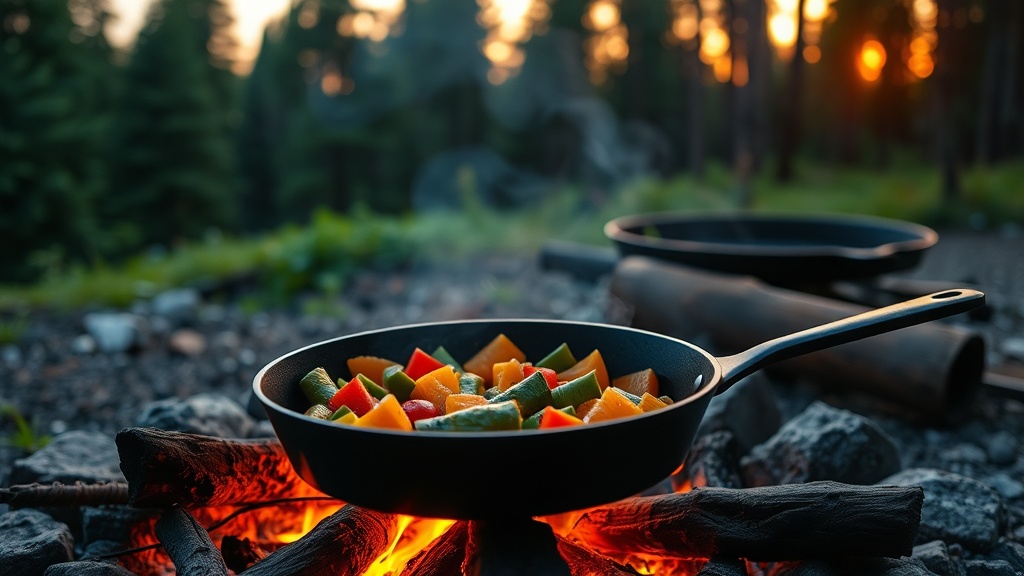
I know, I know — it's heavy. I've heard every lightweight-packing argument in the book. And for backpacking? Sure, leave the cast iron at home and bring your titanium pot. But if you're car camping or have a van or trailer, a 10-inch cast iron skillet and a Dutch oven will do 90% of everything you'll ever want to cook at camp.
Here's why cast iron beats everything else over a campfire:
- Heat distribution. Campfire heat is wildly uneven. Cast iron absorbs and spreads it out so you don't get hot spots that burn your food.
- Durability. I've dropped my Lodge skillet on rocks, left it in the rain (not on purpose — long story involving a raccoon), and accidentally buried it in coals. Still works perfectly.
- Versatility. Sauté, fry, bake, simmer. One pan. I've made pancakes, seared trout, baked cornbread, and reheated last night's stew all in the same skillet on the same trip.
My current kit: a Lodge 10.25-inch skillet and a Lodge 6-quart Dutch oven. That's it. They've been in the van for four years.
Stop Bringing Complicated Recipes
I see these camping recipe blogs with ingredients lists 20 items long — fresh herbs, heavy cream, three kinds of cheese, a pound of unsalted butter. Who are these people? Where are they keeping the heavy cream on day three of a boondocking trip?
My campfire cooking philosophy is dead simple: three to five ingredients, one pot or pan, real food.
Some of my staples:
- Skillet hash: Diced potatoes (par-boiled at home before the trip), onion, whatever protein is on hand. Salt, pepper, hot sauce. Done.
- Foil packets: Sausage, peppers, potatoes, olive oil. Wrap tight, toss on coals, 20 minutes.
- Dutch oven chili: Brown meat, dump in canned beans, canned tomatoes, chili powder. That's it. An hour over low coals and it's the best thing you'll eat all week.
- Cowboy coffee: Boil water, throw in grounds, let it settle. It's not pretty but after a cold night in the desert it tastes like heaven.
If your recipe requires more than one cutting board or any appliance that plugs in, save it for home.
The Grate Matters More Than You Think
Most campground fire rings come with a grate. Some are fine. Many are wobbly, rusted, or at the wrong height. I carry a small folding campfire grill grate in the van — it cost about $25 and it's one of the best pieces of gear I own.
You want the grate 6-8 inches above your coals. Too close and everything burns. Too far and you're waiting an hour for water to boil. If the campground grate is too high or too low, I use rocks to adjust — stack a few flat stones on either side and lay my grate across. Primitive? Sure. Works every time.
Wind Is Your Worst Enemy
More than rain. More than wet wood. Wind will ruin a campfire meal faster than anything. It pushes flames sideways, creates uneven heat, blows ash into your food, and turns a controlled cook into chaos.
My fixes:
- Position your fire ring so the wind pushes smoke AWAY from where you're cooking. This sounds obvious but I see people set up camp facing into the wind constantly.
- Use a windscreen. Even a makeshift one from your cooler or a large flat rock helps enormously.
- Cook lower. In windy conditions I keep my grate as close to the coals as I can — 4 inches — and use the cast iron to buffer the heat fluctuations.
If it's truly howling? That's a camp stove night. No shame in that.
Clean Up Is Part of the Process
I'll be honest: for years I was terrible about cleaning my cast iron at camp. I'd let it sit, scrape it out in the morning, and wonder why things stuck the next time. Turns out "season it at home and neglect it in the field" isn't a maintenance plan.
Now I clean up while the fire's still going. A little hot water in the skillet, a chain mail scrubber (best $15 I ever spent), wipe it out, and put it back on the coals for 30 seconds to dry. Takes two minutes. My cast iron has never cooked better since I started actually taking care of it in the field.
It Gets Better Every Time
Campfire cooking isn't something you master from reading a blog post — including this one. It's a feel thing. You learn how your particular fire ring holds coals, how the wood in this region burns, how the altitude affects boiling time, how to tell by the sound whether your skillet is hot enough.
After 22 years I can glance at a fire and tell you whether it's ready to cook on. That's not talent — it's just reps. Give yourself permission to burn a few meals. It's part of the deal.
The payoff is worth it. There is genuinely nothing — not a single restaurant meal in the world — that tastes as good as a simple skillet dinner cooked over coals, eaten at a picnic table, with dirt on your hands and pine trees overhead. Nothing even comes close.
Now go burn some food. You'll figure it out.