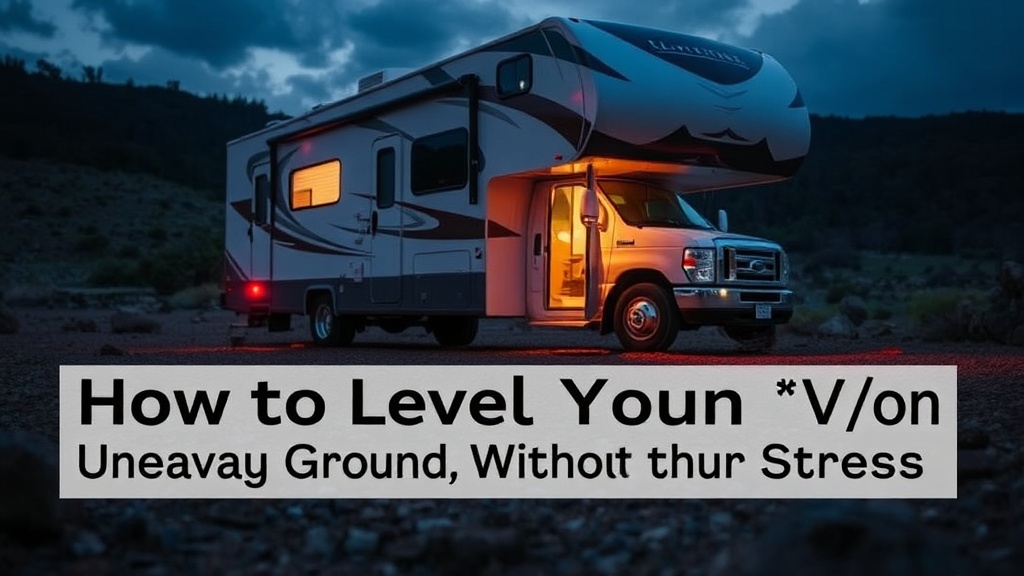
How to Level Your RV on Uneven Ground Without the Stress

This post covers the exact steps, tools, and troubleshooting tips for leveling an RV on uneven ground—whether that's a sloped Forest Service site outside Moab or a crowned county park pad. An unlevel RV isn't just annoying. It strains the refrigerator, warps slide-out seals, turns sleep into a gravity-defying stunt, and can void appliance warranties. Getting the rig flat takes about ten minutes once the system is dialed in, and the payoff is a stable home base, proper drainage, and appliances that keep running for years.
What happens if an RV isn't level?
The short answer: appliance damage, water drainage issues, and terrible sleep. When an RV tilts more than three degrees off-level, the absorption refrigerator can fail permanently. The ammonia coolant inside depends on gravity to cycle properly through the coils. (Running it tilted is a bit like driving with no oil—the damage doesn't always show up immediately, but it accumulates fast.) Water won't drain from sinks or the shower pan, so gray tanks back up into the stall. Cabinet doors swing open. Pantry contents slide to one side. Sleep quality drops because the body senses the slope and fights it all night.
Over time, slide-out mechanisms bind and rubber seals distort, creating leaks during the next rainstorm. Tank sensors read incorrectly when fluids pool to one side, so the monitor panel claims a tank is half-full when it's actually overflowing. The catch? Most campers don't notice the slope until morning, by which point the fridge has been struggling for eight hours.
What tools do you need to level an RV on uneven ground?
You need three categories: something to raise wheels, something to measure slope, and something to prevent rolling. Here's the thing—options range from $20 plastic blocks to $2,000 hydraulic auto-leveling systems, and the right mix depends on rig size, budget, and how remote the campsites get.
| Product | Type | Best For | Approx. Price |
|---|---|---|---|
| Lynx Levelers | Interlocking plastic blocks | Small to mid-size trailers, gross adjustments | $30–$50 |
| Andersen Hitches Camper Leveler | Curved drive-on ramp | Single-axle trailers, fast fine-tuning | $80–$100 |
| BAL Leveler | Scissor-style jack between tires | Tandem-axle trailers, stable lifts | $150–$200 |
| LevelMatePRO | Bluetooth inclinometer | Measuring slope from the driver's seat | $140 |
| RamPro Rubber Wheel Chocks | Solid rubber chocks | All RVs, preventing roll on gravel or asphalt | $20–$40 |
Worth noting: many full-timers carry two systems. Lynx Levelers work well for gross adjustments on rutted Forest Service roads, while an Andersen Camper Leveler speeds up fine-tuning at developed campgrounds. The LevelMatePRO pairs with a smartphone app and removes the guesswork—no more hopping out to eyeball bubble levels. For budget builds, a simple 9-inch aluminum torpedo level from the hardware store and a bag of treated 2×6 lumber scraps will get the job done. That said, wood rots and splits, so check it seasonally.
How do you level an RV step by step on sloped campsites?
The goal is side-to-side first, then front-to-back. Here's a proven sequence used by backcountry campers and KOA regulars alike.
1. Scout the pad before pulling in
Walk the site. Look for high spots, ruts, tree roots, and soft mud. A spot that looks flat from the driver's seat can hide a six-inch dip right where the galley slide needs to land. After heavy rain, soft ground swallows blocks. (Campgrounds near the Olympic Peninsula are famous for this.) Kick the dirt. If it squishes, plan on a wider footprint for the blocks—or choose a different site.
2. Position for side-to-side leveling
If the slope runs left to right, the low-side tires need lifting. For single-axle trailers, set the leveling device—blocks or an Andersen ramp—directly in front of the low-side tire. Drive up slowly. A spotter standing where they can see both wheels is invaluable. For tandem-axle rigs, place blocks ahead of both tires on the low side. Raising only one axle on a tandem trailer creates torque on the frame and can pop a tire off the rim.
3. Chock every wheel immediately
Never unhitch or climb inside until wheel chocks are snug against both sides of every tire. Roll-aways happen in seconds, and insurance won't cover a rig that slides into a picnic table because someone skipped this step. RamPro rubber chocks grip asphalt, gravel, and even wet grass better than cheap plastic wedges.
4. Unhitch and level front-to-back
For travel trailers, raise the tongue jack until the coupler separates from the hitch ball. Then extend or retract the jack until the trailer is flat from nose to tail. For fifth-wheels, the landing jacks do this work. Motorhome owners skip the unhitching step and move straight to adjusting the built-in leveling jacks—usually hydraulic on Class A rigs, electric scissor jacks on smaller Class C coaches.
5. Deploy stabilizer jacks
Stabilizer jacks are not for leveling. Their job is to prevent the rocking motion that happens when someone walks from the bedroom to the kitchen. Drop them until they make firm contact with the ground or a stack of blocks, then give them maybe a quarter turn more. Over-tightening bends the frame, strips the gears, and can actually push the RV out of level.
6. Verify with the refrigerator test
Open the freezer door. If the ice tray doesn't slide out on its own, the rig is close enough. For precision, the LevelMatePRO app shows exact degrees. Most manufacturers recommend keeping the refrigerator within two to three degrees of level in both directions.
What are common leveling mistakes to avoid?
Stacking blocks too high tops the list. More than four inches of lift puts serious stress on suspension components and increases the chance that a tire will slip off the stack when someone shifts weight inside. That said, some campers try to level using stabilizer jacks alone. That's a frame-bending shortcut that ends in expensive repairs and voided warranties.
Another mistake: forgetting to account for slide-outs. When slides extend, they shift thousands of pounds to one side. A rig that measures perfectly level before the slides go out might drop two degrees afterward—enough to cause refrigerator problems. Always deploy the slides, then check the levels again. If the rig dropped, adjust the stabilizers or add a block under the low-side jack foot.
Also, skipping the wheel chocks on "flat" pavement is a gamble. Asphalt can have a subtle crown, and transmissions aren't perfect parking brakes. A runaway trailer at a national park campground ruins more than the afternoon.
How do you level an RV without blocks in a pinch?
Sometimes blocks crack, sink into mud, or get left at the last dump station. The first fallback is natural materials. Flat, smooth rocks wider than the tire footprint can support weight if stacked carefully—no wobbling. Wood scraps from a campfire ring work too, provided they're dry and at least as wide as the tire. (Wet wood compresses and can spit nails.)
The second option is repositioning. Many campsites have a slight crown in the center of the pad. Pulling forward or backward six feet can cut the slope in half. At developed campgrounds—like those along the U.S. Forest Service roads in the Blue Ridge Mountains—paved sites often have sweet spots near the edges where the ground meets the shoulder.
Third: ask the neighbors. The RV community shares gear freely. A borrowed Lynx block or two solves the problem until the next stop at an outdoor gear shop. Many campers keep a spare set of chocks and blocks specifically to loan out.
Finally, if the slope is severe and no materials are available, sleeping with the refrigerator off and leveling in the morning is better than destroying the cooling unit overnight. Drain the freshwater tank to lower the center of gravity, and park with the nose uphill so the gray and black tanks don't back-feed.
Leveling an RV on uneven ground becomes second nature after a few dozen setups. The right tools—whether that's a bag of Lynx Levelers, an Andersen Camper Leveler, or just a trustworthy bubble level and a patient spotter—turn a frustrating chore into a quick routine. Check the fridge, chock the wheels, and sleep soundly knowing the rig won't roll into the fire pit.
Steps
- 1
Assess the Slope and Position Your RV
- 2
Use Leveling Blocks or Ramps Under Low Wheels
- 3
Extend Stabilizer Jacks and Recheck with a Bubble Level