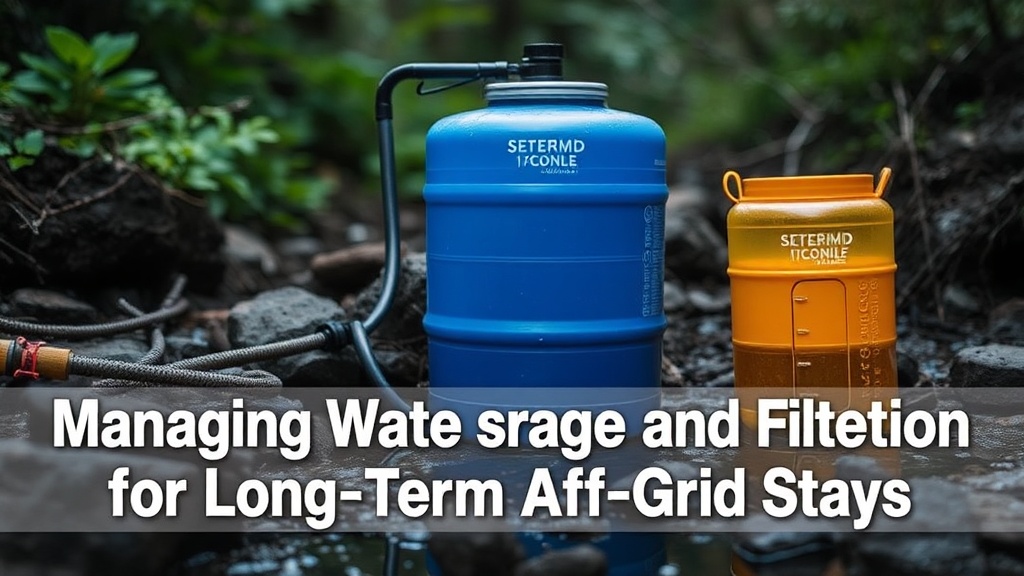
Managing Water Storage and Filtration for Long-Term Off-Grid Stays

What You'll Learn About Managing Water While Off-Grid
You're going to learn how to manage your water supply when you don't have a hookup nearby. This guide covers the practicalities of storing, treating, and rationing water while living in a van or travel trailer. We'll look at the math behind your daily usage, the different types of filtration systems available, and how to keep your water tasting fresh even after sitting in a tank for a week.
When you're living on public lands or in a remote campsite, water isn't just a luxury—it's your most vital resource. I've spent plenty of nights realizing I ran out of water just as I was about to make coffee, and that's a mistake you don't want to make. Whether you're using a small 5-gallon jug or a 30-gallon fixed tank in your van, your approach to management changes based on your setup.
How much water do I actually need for a road trip?
The first mistake people make is underestimating how much water they'll use for things besides drinking. You need water for drinking, brushing teeth, washing hands, and cleaning up after meals. A good rule of thumb is to plan for at least one gallon of water per person, per day, for drinking alone. But once you add in cooking pasta, washing a single coffee mug, and wiping down a counter, that number jumps quickly.
If you're living in a van with a small footprint, you might get away with less, but if you're in a larger travel trailer, you'll likely go through much more. I always suggest calculating your "worst-case scenario" usage. If you're stuck in a spot for three days due to weather, can you survive on what's left in your tanks? If the answer is no, you need more storage. You can check the official CDC guidelines for water safety to understand the different levels of purification needed for different environments.
The Water Storage Breakdown
There are two main ways to handle water: fixed systems and portable containers. Fixed systems are great for convenience—you just turn a tap and water flows. However, they can be prone to leaks or even freezing in colder climates. Portable containers, like heavy-duty Jerry cans, are much more reliable for long-term storage because you can physically see how much is left.
- Fixed Tanks: Great for pressurized systems, but requires a pump and a battery.
- Gravity-Fed Systems: Simple and reliable; just lift the jug to pour.
- Water Jugs: The most basic, but requires the most manual labor.
I prefer keeping a mix. I use a fixed 5-gallon system for my sink, but I always keep a dedicated, BPA-free 2-gallon jug specifically for drinking water. This prevents the "tank taste" from affecting your hydration and ensures that if my pump fails, I'm not stranded without a drink.
Which water filter is best for camping?
If you're sourcing water from a stream, a lake, or even a public spigot, you can't just drink it straight. Even if the water looks crystal clear, microscopic bacteria and protozoa are often present. You'll need a way to make that water safe. There are three main ways to do this: filtration, purification, and boiling.
Filtration removes particles and some bacteria, while purification (like using UV light or chemical tablets) actually kills viruses. If you're relying on natural sources, a high-quality filter is a must. I've used several different types over the years, and the best one depends on your specific needs. For example, if you're mostly filling up at gas stations, a simple carbon filter might be enough to improve the taste, but if you're pulling from a mountain stream, you need something more heavy-duty.
Check out the EPA's resources on water quality to understand why certain treatments are necessary. For those of us in the van life community, a portable-ready pump filter or a gravity-fed system like a Sawyer Squeeze is a favorite because it doesn't require much power or heavy equipment.
Maintaining Water Freshness
One thing nobody tells you is that water can go stale. If water sits in a plastic tank for weeks, it can develop a funky smell or even a slimy biofilm. This is especially true in the heat. To prevent this, try to rotate your water regularly. Don't let the same batch sit for a month. If you're using a fixed tank, consider adding a tiny bit of food-grade hydrogen peroxide or specialized water treatment drops to keep it fresh during long stretches between refills.
Also, keep your storage containers out of direct sunlight. UV rays can degrade plastic and promote algae growth. I keep my backup jugs in a shaded part of my van, tucked away under the bed or in a storage bin. It makes a massive difference in how the water tastes after a few days of travel.
How do I prevent water from freezing in my van?
If you're camping in the shoulder seasons or higher altitudes, freezing is your biggest enemy. Water expands when it freezes, and a frozen pipe or a cracked tank can ruin your entire trip. If you have a fixed plumbing system, you have to be proactive. I always keep a small piece of insulation around my main hose connections. If the temperature is dropping below freezing, I'll also use a small heater or a heated blanket near my water storage to keep the liquid moving.
When it gets really cold, I've learned to drain my external hoses and empty the lines entirely before bed. It's a pain, but it's a much smaller headache than dealing with a cracked pump or a burst line in the middle of the night. If you're using a portable setup, just bring your water jugs inside the living area with you. It's a simple way to ensure your most precious resource stays liquid through the night.
| Method | Pros | Cons |
|---|---|---|
| Fixed Tank | Convenience, easy access | Prone to freezing, heavy |
| Gravity Jug | Reliable, lightweight | Requires manual lifting |
| UV Purification | Kills viruses/bacteria | Needs power or sunlight |
Managing your water is really about understanding your own rhythm. The more you pay attention to how much you use and how much you have left, the less stress you'll feel when you're miles away from the nearest tap. It's all about being prepared, not just having the gear, but knowing how to use it when the situation gets tough.