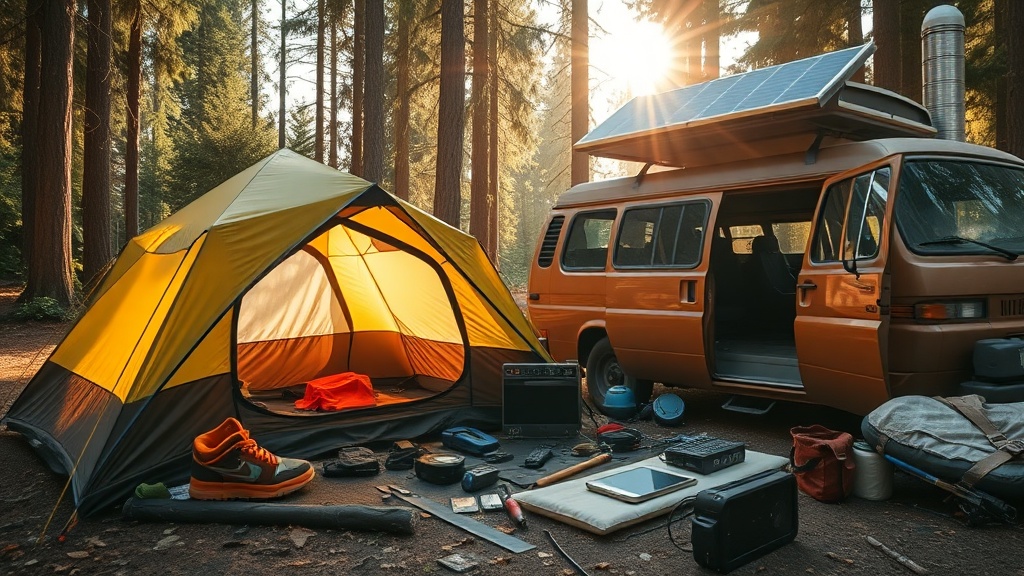
Spring 2026 Camping Gear: Hype vs. Reality After 600+ Nights Outside

Every spring, the outdoor industry drops a new wave of gear designed to convince you that last year's setup is somehow inadequate. I've been watching this cycle for 22 years, and I've learned exactly one thing: about 80% of it is marketing, and the other 20% will genuinely change how you camp.
Spring 2026 is no different. So I went through the major launches, the Reddit hype, the gear blogs, and the REI new arrivals — and here's my honest take on what's actually worth paying attention to and what you can safely ignore.
Blackout Tents: Finally, a Trend I Can Get Behind
I resisted blackout tents for years. Seemed gimmicky. Then I borrowed a Coleman Sundome Dark Room on a July trip to eastern Oregon where sunrise hits at 5:15 AM, and I slept until 7:30 without waking up once.
That never happens to me. I'm a light sleeper in the woods — always have been. Every headlamp passing by, every hint of dawn, and I'm up staring at the tent ceiling.
The technology is simple: a coating on the tent fabric that blocks 90%+ of sunlight. No batteries, no moving parts, nothing to break. Coleman's Dark Room line does it well at a reasonable price point (the Sundome 4-person runs about $140), and Quechua's Fresh & Black tents are solid if you can find them. The Crua tents go even further with 99% light blocking, but they cost accordingly.
My take: If you camp in summer and you're a light sleeper, this is the most underrated upgrade you can make. It also keeps the tent noticeably cooler in direct sun, which is a genuine bonus I didn't expect. Worth it.
Self-Erecting Tents: Cool, But I Have Questions
The "instant setup" tent category keeps growing. Pop-up designs that go from bag to standing structure in under a minute. Some of the 2026 models are legitimately impressive — full-size family tents that practically assemble themselves.
Here's my problem: I've been setting up tents for over two decades. A good tent takes me maybe eight minutes. So "instant" saves me eight minutes, but it also means a tent I can't repair in the field as easily, with proprietary mechanisms that might fail at the worst possible time.
I saw a guy at a campground in Moab last fall fighting with a pop-up tent that wouldn't fold back down. Spent 45 minutes on it. The "instant" part works fine. It's the "instant putting it away" part that nobody talks about.
My take: Fine for car camping where you're setting up once and staying put. I wouldn't rely on one for anything where you need to move camp or where a mechanical failure means sleeping under the stars (unless that's your thing). Stick with a quality freestanding tent you know how to pitch blindfolded.
Biometric-Inspired Gear: The Hype Machine Is Working Overtime
I keep seeing products marketed with terms like "Voronoi polygon modeling" and "biological surface mapping." A pillow shaped like fungal spores. A sleeping pad with "vascular geometry."
Look, I'm not an engineer. Maybe these designs are genuinely better. But I've been sleeping on a Therm-a-Rest NeoAir for years, and it works because it's light, it insulates, and it doesn't pop. I don't need my sleeping pad to have a biology degree.
What I've found over 600+ nights outside is that comfort comes from three things: adequate insulation from the ground (R-value matters more than surface texture), enough width that you're not rolling off the edge, and a pillow situation that doesn't feel like sleeping on a rolled-up sweater. You can solve all three for under $200 total, and no amount of biomimicry is going to replace getting the basics right.
My take: Wait for real field reviews from people who've used these products for a full season before buying. First-generation "innovative" designs have a 50/50 track record of being great or being returned.
REI's Westward Line: Pretty, But Let's Talk Price
REI just launched their Westward collection — tents, shelters, chairs, sleeping pads — all designed around creating an "envy-worthy homebase." Their words, not mine. The Westward 6 tent is $549. The self-inflating bed is $199-$219. The camp chair is $130.
I'll be honest: the gear looks beautiful. REI's in-house designs have gotten genuinely good. But "envy-worthy homebase" is a phrase designed for Instagram, not for someone who actually camps 30+ nights a year.
You know what my homebase looks like? A 10-year-old tent with a patched rain fly, camp chairs I bought at a swap meet for $15 each, and a sleeping setup I've dialed in over years of trial and error. Nobody's envying it. But it works perfectly, it's paid for itself ten times over, and I'm not worried about getting mud on a $130 chair.
My take: If you're starting from scratch and want quality gear in one cohesive line, REI's Westward stuff is probably solid. But if you already have functional gear? Spending $549 on a tent because it matches your shelter and your chair is not camping — it's decorating.
Solar and Power Independence: This One's Real
The shift toward solar panels and portable power stations isn't hype — it's the most significant practical improvement in camping I've seen in the last five years. Newer portable panels are lighter, more efficient, and actually produce enough juice to keep phones, headlamps, and small devices charged indefinitely.
Mike and I run a 200W panel on the Transit's roof with a 500Wh power station inside, and it changed our boondocking completely. We went from rationing phone battery to running a small fan on hot nights and keeping a powered cooler going. Total investment was around $600, and it's been running three seasons with zero issues.
The 2026 models are even better — lighter panels, faster charging, and some RV manufacturers are building power packages in from the factory. If you do any extended camping or dispersed camping, this should be your priority upgrade over any tent, chair, or biomimetic pillow.
My take: This is the real deal. If you haven't looked at portable solar since 2022, the technology has jumped significantly. A 100W panel and a decent power station (Jackery, Bluetti, EcoFlow — all solid) will cost $300-500 and will fundamentally change how long you can stay out.
The Bottom Line
Here's what I'd actually spend money on this spring, in order:
- Portable solar + power station if you don't have one yet. Biggest bang for your dollar.
- A blackout tent if summer sleep is a struggle. Cheap, effective, no downsides.
- Replace anything that's actually worn out — a leaky rain fly, a sleeping pad that's lost its insulation, camp shoes with no sole left.
And here's what I'd skip:
- Anything marketed primarily with scientific-sounding buzzwords and no field-test data.
- Matching gear sets designed for aesthetics over function.
- Self-erecting tents unless you have a specific accessibility need for them.
Your gear doesn't need to be new. It doesn't need to be pretty. It needs to work, reliably, night after night, in weather you didn't plan for. That's what 22 years and 600 nights will teach you — and no spring product launch is going to change the fundamentals.