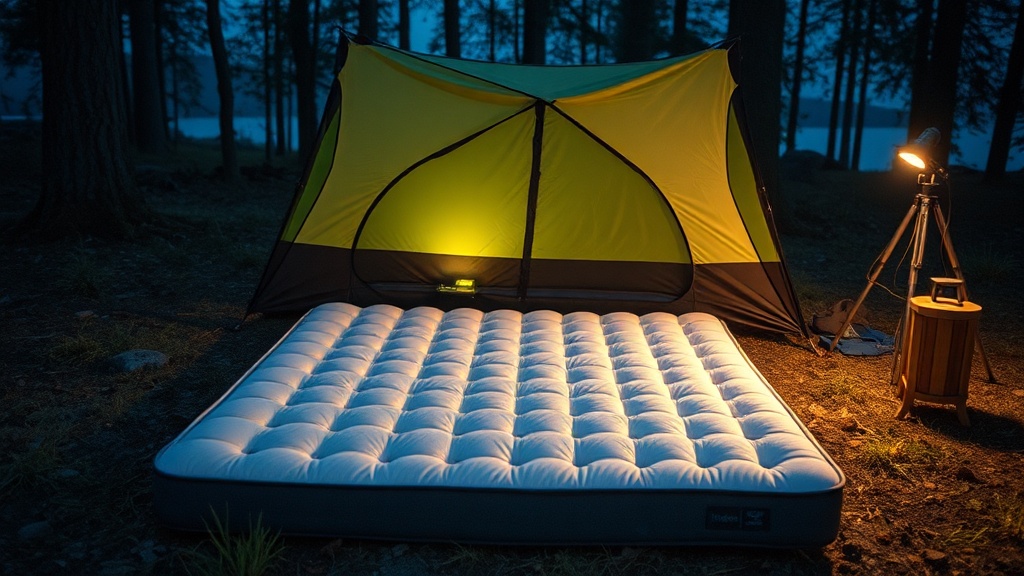
Why Your Camp Mattress Feels Like Sleeping on the Ground

The Problem with Sleeping on Hard Surfaces
You wake up in the middle of the night at a BLM (Bureau of Land Management) site in Moab, feeling a sharp pressure in your lower back or a dull ache in your hips. You look down and realize that despite having a thick-looking foam pad or an air mattress, you can still feel the uneven texture of the ground beneath you. This discomfort isn't just a minor annoyance; it is the result of poor thermal regulation, inadequate pressure relief, or a fundamental mismatch between your sleeping gear and your sleeping surface. This guide explains the mechanical reasons why your camp mattress is failing you and how to select gear that actually provides restorative sleep while traveling.
A common mistake in the camping community is assuming that "thicker" automatically means "more comfortable." Whether you are sleeping in a converted Sprinter van, a heavy-duty travel trailer, or a simple tent on a forest floor, your sleep quality depends on three specific factors: insulation, loft, and surface leveling. If you ignore these, you will spend your road trip recovering from exhaustion rather than enjoying the scenery.
1. The Insulation Gap: Why You Feel the Cold Ground
Many campers believe that a thick air mattress is enough to keep them warm, but they are overlooking the R-value. The R-value measures a material's resistance to heat flow. If you are camping in high-altitude areas like the Sierra Nevada mountains or even during a cool spring night in the Ozarks, a standard air mattress acts as a heat sink. It pulls the warmth directly out of your body and transfers it into the cold earth through conduction.
When you use a cheap, single-wall air mattress without any insulation, the air inside the mattress also becomes cold. This creates a chilling effect that can lead to muscle stiffness and poor sleep cycles. To solve this, you need to look for gear with a high R-value. For three-season camping, aim for an R-value of at least 3.0. For extended stays in colder climates or winter camping, you should look for a combination of a high-quality sleeping pad and a dedicated thermal liner or a heavy wool blanket.
How to Check Your R-Value
- Check the Product Specs: Manufacturers like Therm-a-Rest or Nemo list the R-value clearly on the packaging or website.
- Understand Seasonal Ratings: A pad rated 1.5 is strictly for summer; a pad rated 4.0+ is suitable for much colder environments.
- Layering Technique: If you already own a low-R-value mattress, place a closed-cell foam pad (like a Therm-a-Rest Z Lite) underneath your air mattress to create a thermal barrier.
2. The Air Pressure Paradox: Why "Firm" Isn't Always Better
The most frequent error when using air mattresses—especially in van builds or small trailers—is over-inflating them. When you pump a mattress to its maximum capacity, the internal air pressure becomes so high that the material becomes rigid and unforgiving. This creates "pressure points" on your hips, shoulders, and heels. Instead of the mattress contouring to your body, your body is forced to conform to the shape of the mattress.
Conversely, under-inflating the mattress causes the material to sag into the uneven dips of the ground or the floor of your vehicle. If you are sleeping in a converted van, even a slight tilt in the floorboards can become an agonizing ridge if your mattress is too soft. The goal is to find the "Goldilocks" zone: enough pressure to support your weight without bottoming out, but enough softness to allow for natural movement.
The Test for Proper Inflation
To find the right pressure, use the "Fist Test." Place your fist on the center of the mattress. If the mattress feels like a hard wooden board, you have over-inflated it. If you can easily push your fist through to the floor, it is too soft. You want enough resistance that your fist meets significant pressure, but there is still a slight "give" to the surface.
3. Surface Irregularities and the "Bottoming Out" Effect
In a tent or a vehicle, you are rarely sleeping on a perfectly flat surface. Debris, tree roots, or the structural ribs of a van floor can create localized high points. If your mattress lacks sufficient "loft" or density, your body weight will compress the air or foam until you hit that hard spot. This is known as "bottoming out."
This is particularly problematic with lightweight, ultralight backpacking pads. While these are excellent for weight savings, they often lack the volume necessary for side sleepers. Side sleepers require more compression at the hip and shoulder areas. If you are a side sleeper, you need a mattress with a higher profile (at least 3 inches of depth) to ensure your skeletal structure remains aligned.
Matching Mattress Type to Your Setup
- Van/Trailer Living: Use a combination of a 2-inch high-density foam topper and a specialized van mattress. This provides a stable base that ignores the small bumps in the vehicle floor.
- Tent Camping: Use an insulated air pad with a high R-value. The ground is more uneven in a tent than in a vehicle, so you need more "cushion" to absorb the irregularities.
- Minimalist/Backpacking: Focus on high-quality closed-cell foam or high-end inflatable pads that offer a balance of weight and R-value.
4. The Importance of Breathability and Moisture Control
If you feel sweaty or damp when you wake up, your mattress might be causing condensation. This is a common issue in small spaces like camper vans or small tents. As you breathe and sweat during the night, moisture is released. If your mattress is made of non-breathable plastic or heavy vinyl, that moisture gets trapped between your body and the mattress, creating a damp, cold microclimate.
This moisture can eventually seep into your sleeping bag or your bedding, making you feel much colder than the actual ambient temperature. To prevent this, look for mattresses that use breathable fabrics or incorporate a top layer of fabric rather than pure PVC. Additionally, ensuring proper ventilation in your sleeping area—such as cracking a window in your van or a vent in your tent—is crucial for managing the humidity levels that affect your sleep quality.
Summary Checklist for Better Sleep Outdoors
Before your next road trip or camping excursion, run through this checklist to ensure your sleep system is ready for the terrain and temperature:
- Verify the R-value: Does it match the lowest expected temperature of your destination?
- Test the Inflation: Use the Fist Test to ensure you haven't created a rigid, uncomfortable surface.
- Evaluate Your Sleeping Position: If you are a side sleeper, do you have at least 3 inches of loft to protect your hips?
- Check for Surface Leveling: If camping in a vehicle, is there a foam base to prevent "bottoming out" on floor ribs?
- Plan for Moisture: Do you have a way to manage condensation, such as a breathable top layer or adequate ventilation?
Investing time in your sleep setup is just as important as prepping your stove or your vehicle's battery. A well-rested camper is a safer, more capable camper. When you stop fighting your mattress, you can actually focus on the experience of being outdoors.