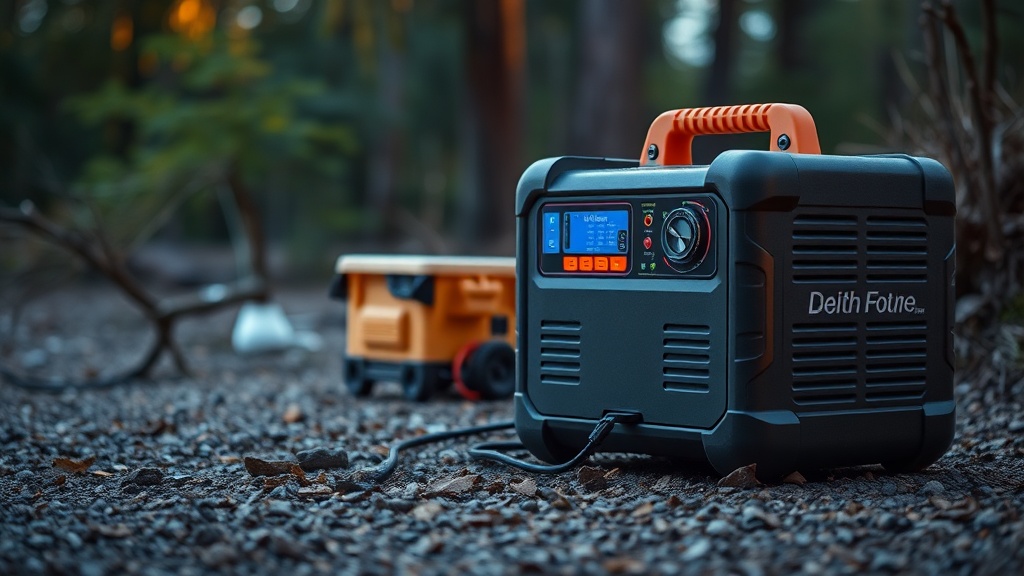
Why Your Portable Power Station Might Be Failing You

Many people assume that a high-capacity portable power station is a "set it and forget it" solution for off-grid camping. They see a large battery capacity on a spec sheet and assume that translates to endless electricity for their coffee maker, laptop, and lights. This is a mistake. A big battery doesn't mean much if you don't understand the actual draw of your devices or the environmental factors that drain your juice. If you're planning a long road trip or a week of dispersed camping, relying on a single battery without a real understanding of power math is a recipe for a dark, cold campsite.
The real issue isn't just the size of the battery; it's the efficiency of the entire system. Most beginners overlook the difference between AC and DC power consumption. If you're plugging a small lamp into an AC outlet on your power station, you're actually losing a significant chunk of your energy to the inverter itself. That inverter—the piece of hardware that converts battery power to household-style electricity—is constantly sipping energy just to stay turned on. This "phantom draw" can eat through your reserves even when you aren't actually using any devices. It's a quiet drain that turns a three-day trip into a one-day struggle.
How much power does a camping trip actually require?
To figure this out, you can't just guess. You have to look at your gear. I always suggest keeping a running log of what you use. Are you running a high-wattage device like a heating element or a hair dryer? Even if you only use it for two minutes, the surge can be massive. Most portable power stations are great for low-wattage electronics—think phones, tablets, or even a small LED light—but they struggle with anything that generates heat. If you're trying to run a coffee maker or a small toaster, you'll likely trip the circuit or drain your battery far faster than your math predicted.
Let's look at a common scenario. If you have a 1000Wh (watt-hour) power station, you might think you have 1000Wh of usable energy. In reality, once you account for the inverter inefficiency and the natural discharge rate, you might only have 800Wh or 850Wh of actual usable power. If you're running a laptop that pulls 60W, you'll think you have 16 hours of runtime. But if you're also keeping a small light on and the inverter is running, that 16 hours shrinks quickly. It's better to be conservative with your calculations so you aren't left staring at a dead screen in the middle of the woods.
Can I charge my power station with solar panels?
This is where many travelers run into trouble. You see a beautiful, sunny day and assume your solar panels will keep your battery topped off indefinitely. However, solar charging isn't a constant stream of energy; it's a fluctuating, often unreliable source. Depending on the angle of the sun, cloud cover, and even the temperature, your actual input might be much lower than the advertised maximum. If your power station says it can handle 200W of solar, that's a peak number—not a guarantee.
To make solar work for your road trip, you need to treat it as a supplement, not a primary source. I've learned through years of living in a van that you have to be proactive. Don't wait until the battery is at 20% to start looking for a sunny spot. I prefer to set up my panels as early in the morning as possible to catch the most efficient light. If you want to dive deeper into how solar works, the National Renewable Energy Laboratory provides incredible technical data on how sunlight converts to usable electricity, which can help you understand why your panels might be underperforming on a cloudy afternoon.
What is the best way to manage battery life while camping?
The best way to manage your power is through disciplined habits. First, prioritize DC over AC whenever possible. If your device can run off a USB port or a 12V cigarette lighter socket, use that. It bypasses the energy-hungry inverter entirely. Second, turn things off. It sounds simple, but if you're using a power station to run a small fan to circulate air in your van, don't leave it running while you're out for a hike. Every minute it's on, it's taking a bite out of your reserves.
Another pro tip is to monitor your battery's temperature. Batteries—especially Lithium-ion and LiFePO4 types—are sensitive to the elements. If it's freezing outside, the chemical reactions slow down, and your capacity will drop. If it's sweltering, the internal resistance increases. Keeping your power station in a temperature-controlled environment, like inside your cooled van or a well-insulated storage box, can help maintain efficiency. For more on environmental impact and sustainable gear usage, checking out resources like the EPA website can give you a better sense of how much energy consumption impacts the natural spaces we love to visit.
How do I choose the right capacity for my needs?
Don't buy based on what you think you'll use; buy based on what you actually use. I've seen people buy massive, expensive 2000Wh power stations for a weekend trip when a 500Wh unit would have sufficed. This adds unnecessary weight to your vehicle and a lot of extra cost. If you're a minimalist who just needs to keep a phone and a headlamp charged, a smaller, more portable unit is actually the smarter choice. If you're planning for long-term stays in remote areas where you won't see a plug for a week, then the larger capacity is a necessity.
| Device Type | Typical Wattage | Impact on Battery |
|---|---|---|
| Smartphone | 5-10W | Very Low |
| Laptop | 45-90W | Moderate |
| Electric Kettle | 1000-1500W | Extremely High |
| Portable Fan | 15-30W | Low |
| LED Camp Light | 5-10W | Very Low |
As we approach Earth Day, it's also worth considering the lifecycle of the gear we use. Choosing high-quality, durable power stations that can be repaired or upgraded is much better for the environment than buying a cheap, disposable unit that ends up in a landfill after one season. Being an intentional consumer—whether it's your camping gear or your daily electronics—is one of the best ways to practice low-impact adventure. Protecting the wild places we visit starts with the choices we make in our gear sheds and garage's long before we even hit the road.
Ultimately, your power station is only as good as your ability to manage it. If you treat it like a finite resource rather than an infinite well, you'll find much more success on your travels. Pay attention to the small things: the phantom draws, the temperature shifts, and the inefficient conversions. Those are the details that separate a frustrating trip from a seamless one.